 Drag to turn
Five-finger tendon hand
Idea“A five-finger hand with slim, tendon-driven fingers and every motor tucked into the forearm.”
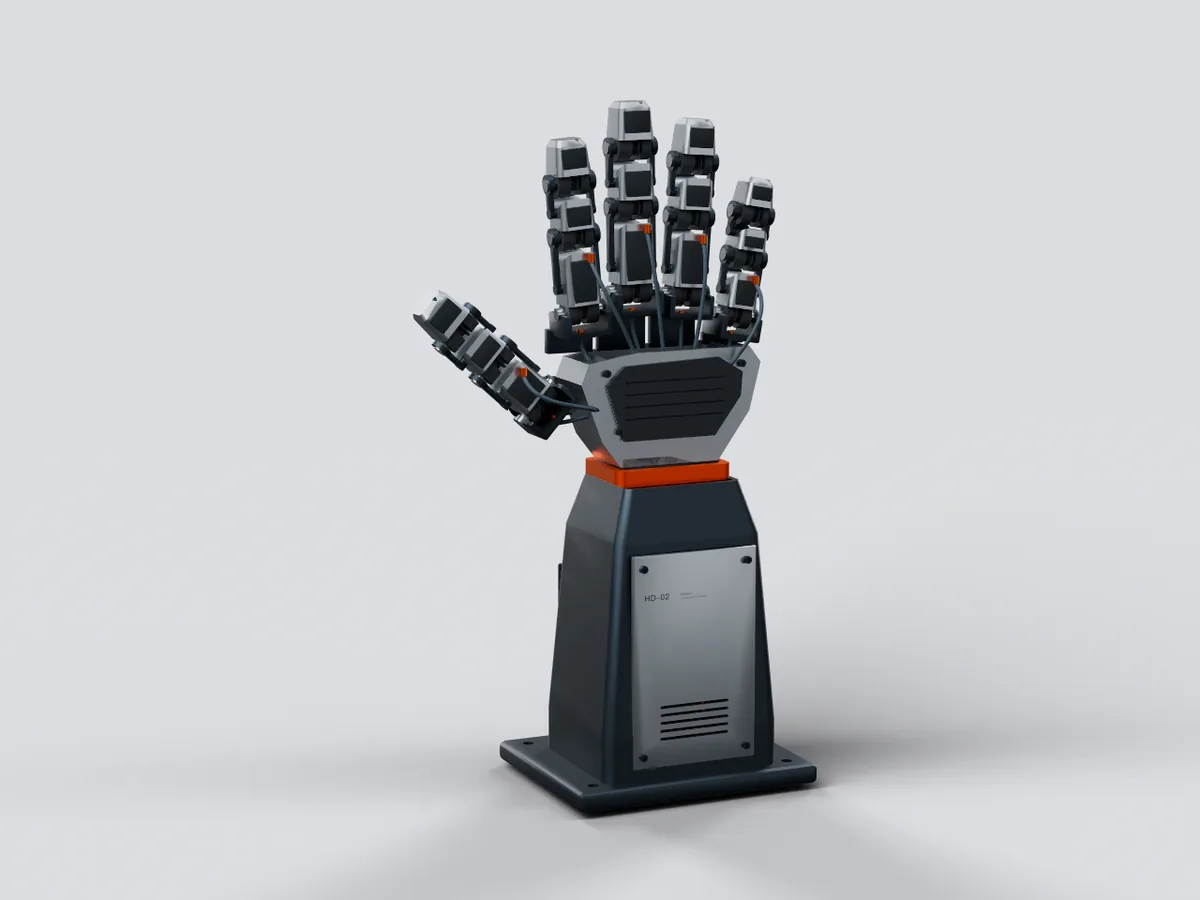
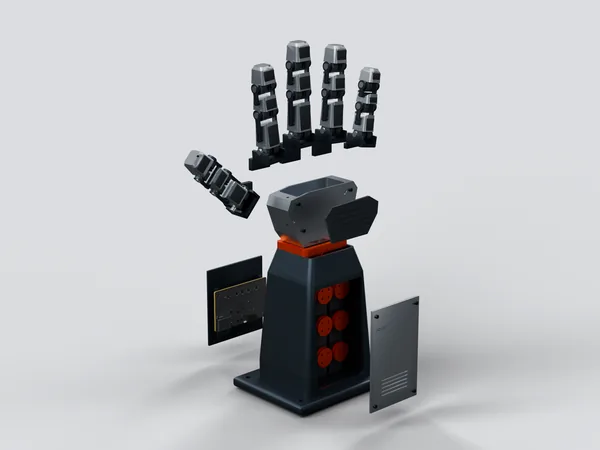
A five-finger hand whose motors sit in its forearm. Eleven smart servos in a cassette pull tendons through housings in the wrist: each finger has one for its knuckle and one shared by its two outer joints, and the thumb, set on the side of the palm, has three. Together they drive sixteen joints in slim fingers with dark rubber pads. It stands 341 mm tall on a bench base, with an orange collar at the wrist and the controller board behind the forearm's rear cover.
Pre-orderPre-orders aren't open yet. This adds you to the waitlist for this product, and nothing is charged.
See it come apart
One turn around the design, while its parts move apart and go back together. Rendered from the design files, like the view above. It isn't footage of a real unit.
Product facts
- Size, standing
- 341 mm tall on a 130 × 106 mm base, 192 mm across with the thumb out
- Joints
- 16: 3 per finger, 4 in the thumb; no spread joints
- Motors
- 11 × XL330-M288 servos in the forearm: 2 per finger, 3 for the thumb
- Drive
- Tendons in 2 mm housings along 11 routed paths through the wrist; springs are planned to return the joints
- Tendon pull
- 15 N at the proposed motor limit, 9 N at an assumed 60% efficiency; calculated, not measured
- Joint travel checked
- Knuckle 75°, middle 75°, tip 50°; thumb opposition 50°
- Parts
- 185, none overlapping; the narrowest gap is 1.0 mm
- Collision check
- No collisions in the open, curl and pinch poses or in 64 sampled poses
- Tendon housings
- At least 2.54 mm apart (2.4 mm needed) and bent no tighter than 8.8 mm (8 mm target), with no sampled point inside a part
- Board
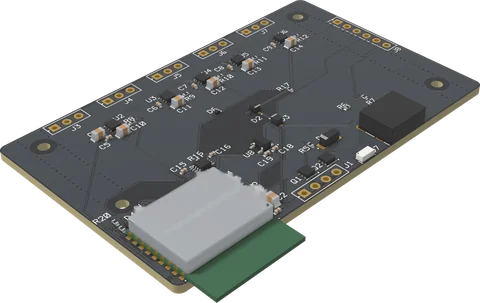
- Its own controller, behind the motors: 74 × 46 mm, 4 layers, 60 parts fitted
- Board checks
- Electrical rules, routing and manufacturing passed
From the design files, November 2026.
What isn't done yet
- No firmware: nothing yet moves a joint or limits a motor's torque.
- No grasp has been tried, in simulation or on a bench. No grip force, payload or endurance is claimed, and our first hand design's simulation results don't carry over.
- The controller board was designed for this hand and passes its checks, but isn't order-ready: its parts aren't reviewed, 25 BOM lines have no part number and its highest-current paths need checking by hand.
- The servo leads solder into the board, because our parts library has no connector low enough yet. The Wi-Fi antenna sits inside the metal forearm, so as drawn the hand talks over USB.
- The tendons' bare runs and end fittings, the bearings, the return springs and the fasteners still need detailing.
- The housings were checked in the open pose only. How they move with the fingers, cable friction and wear need a prototype finger first.
- Each finger's two outer joints share one tendon, so how they bend against an object is untested.
- The fingers have no spread joints, so the hand can't shape itself round wide or flat objects.
- Nothing has been built, weighed or run; no rating of any kind is claimed.
Inside it
Want one?
Pre-orders aren't open yet. Join the waitlist, and we'll tell you when they are.